Showing posts with label Appetizer/ Snacks. Show all posts

May 1, 2013

Fish Fry (Ooli meen varuval)

 
    Nothing can beat the flavor of fresh local ingredients and I always find that I am never able to replicate the taste of many of my mom's delicacies, be it simple 'paruppu sambhar' or even tomato chutney :) I think it has to do with the taste of the onions, tomatoes, the local vegetables and off course, my mom's 'kai pakkvam' (magic of the hands - In south India, this is a term used to refer to how good a cook one is ). On a recent visit to India, I got to taste 'Ooli meen curry' at a neighbor's place and just loved it. This was the first time I came to know of the 'Ooli meen' which is the Tamil name for the Barracuda fish, found in tropical and sub-tropical waters. Such was my desire to taste this fish again, dad and me were lucky enough to find it at the local fishmongers, that too quite fresh. The usual way we prepare fried fish at home, is to marinate it with salt, chilly powder and turmeric powder. Occasionally mom added corn flour to it or if she found a new recipe, she would spice it up further. This time round, I prepared the fish and found a time saver in the paneer butter masala mix as I didn't feel like adding a whole lot of individual masalas to my fish ;) This masala mix is a combination of  many spices like dry ginger, bay leaf, nutmeg, cardamom, fenugreek leaves, mace, caraway, cashew nuts etc. I must say that it did add a tang to the flavor, so much so, my little son absolutely loved this fried fish and I felt like one good mom, happy that her fledgling finally loved his fish!


Ingredients:

Ooli fish (Barracuda) - 3/4 kgs or 1  1/2 lbs (fish should preferably be fresh and cut into       
                                                                              small 2 inch thick pieces)
Chilly powder - 1 and 1/2 tsp
Turmeric powder - 1/2 tsp
Salt - 1 and 1/2 tsp (add according to taste)
Paneer butter masala powder - 1 and 1/2 tsps
Corn flour - 1 tsp (add 2 tsp, if you want the skin to be crispy )
Oil - 4 tbsps (for shallow frying, I used sunflower oil)

Method:

1) Thoroughly wash the pieces and drain any water from the vessel.
2) Sprinkle turmeric powder, chilly powder, salt, paneer butter masala on the fish and mix them well, so as to evenly coat the pieces.
3) Finally sprinkle the corn flour and mix once more. Leave the fish marinated for an hour or so. You can also cover this with cling wrap and fry it the next day, but there is nothing more delicious than fresh fried fish :)

Marinated fresh ooli meen

4) Heat a heavy bottomed saucepan on high, reducing the flame slightly when it is well heated. Use a regular or non-stick pan, depending on your choice. Smear some oil on the pan and place a few marinated pieces on the pan, leaving enough space to flip them over. Add some more oil on the fish and when one side is slightly cooked, turn over. Allow the fish to cook well on both sides. Next, flip the fish over on its side to cook the sides too. The entire process should take about 10 minutes. You can also deep fry the fish if you so desire. Just be sure to discard the oil used for deep frying, as you wouldn't want the smell and taste of the fried fish to permeate other foods you intend to fry.


Fried fish on the traditional 'Dosai kal'
5) Drain any excess oil on a paper towel. Since this is shallow fried, you will hopefully not need the paper towel :) There you are, fried fish ready! Take a fork and dig in or better still, use your hands......food always tastes better when eaten with the hand.

Note:
  You don't need any chutneys or accompaniments to eat this fried fish. It tastes good as is. If you so desire a chutney or a dip, hot thick mint chutney would be a good bet. Just be sure to check how salty your fish is before you add salt to your chutney.

July 17, 2012

Kara Kadalai (Spicy Peanut snack)

   Peanuts or Monkey nuts have always been a favorite food of mine, albeit ever since I began counting the calories, they are not as dear as before! 'Kara Kadalai' was always a great snack to have, especially during the summer vacations when I loved getting lost, reading my favorite Enid Blyton books. Just loved digging into the kadalai and sipping cold 'Rasna', the most popular flavored drink of those times. Kara Kadalai derives its name from 'Karam', which means 'hot and spicy' in Tamil and 'Kadalai,' meaning peanuts. So it is basically 'Hot and spicy peanuts'. You can find these in most savory shops in south India. I have tasted the shop made kara kadalai......they were deep fried and almost always dark red in color, maybe due to the red chilly flakes added to make them spicy. But they were never anywhere close to the kara kadalai my mom made, either in taste nor appearance. They also seemed to lack the besan coating of the home made kadalai. The measurements given below are based more on judgement rather than accuracy, since I sometimes increase or decrease the quantity of all the ingredients mentioned. To start with, you could use about 1 teacup of raw peanuts and try out this recipe, altering the quantity of all the ingredients. Since my mother used her experience in making this snack, her proportions always went by 'a handful'. This recipe is from her favorite old, handwritten recipe book.This is one easy snack to make, so do try it :)


Kara Kadalai


Ingredients:

Raw Peanuts - 1/4 or 1/2 kgs (use whole peanuts with skin)
Besan (Gramflour/ Chickpea flour)) - 1/4 to 1/2 cup
Chilli powder - 1 tbsps (add more if you like it very spicy)
Salt - 1 tsp or as per taste
Water - 1/4 cup
Oil - 1 cup

Method:

1) Place the raw peanuts in a large bowl and sprinkle just enough water so as to just coat all the nuts with water. Take care not to soak the nuts, else you will get lumps of peanuts while adding besan. Kara kadalai is supposed to have individual peanuts coated in gramflour. Don't worry if the 1/4 cup water mentioned above is not used up entirely. The peanuts should have just enough water, so the besan sticks to them properly. An easy way to do this would be to toss the nuts around in the bowl :)
2) Now add a handful of besan, chilli powder and salt to the peanuts and toss them around till they are well coated in the besan. Taste the raw peanuts to check for salt and chilli powder. Add more besan, chilli and salt, in case you feel it is less. Sprinkle some more water on the peanuts if you feel it is too dry and the besan is not sticking to it. The reason I recommend using a handful of besan at a time, rather than just adding 1/4 or 1/2 cup to the peanuts is to ensure that you don't over coat the nuts in the gramflour. This way you can adjust the flavor. Want to taste more peanuts, add less gramflour. Want a spicy flavor, add more gramflour, salt and chilli powder.


Raw peanuts coated with Gramflour, Chilli powder and Salt
3) Heat the 1 cup oil in a kadai or heavy bottomed saucepan on high flame. Once the oil is ready, test it by adding one peanut. If it sizzles, you should lower the flame and add a handful of nuts to the oil. Fry the nuts on very low flame till it appears light brown in color, taking care to stir them continuously, lest they burn.
4) Place the fried nuts on a paper towel and put them in an airtight container once they are cooled. They should  remain crunchy for upto two weeks.

Note:
  The peanuts will appear to taste soggy when you take them out of the oil. But they will become crunchy once they cool down.
                                                      

May 17, 2012

Peanut Chikki

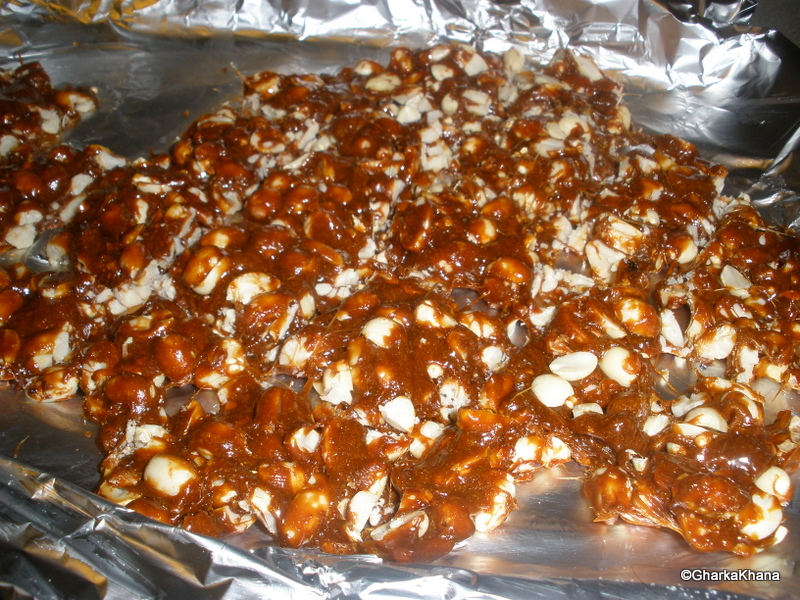
    As a kid, no vacation to my grandma's place was ever complete unless I bit into my favorite 'Kadalai mittai'. I can still remember how we kids used to buy peanut chikki (peanuts and jaggery toffee) from the store near grandma's home.Each small square would be covered with colored dried coconut shavings, mostly pink and yellow colors. I still love kadalai mittai and bring back a packet each time I visit my mother's place.This recipe is a purely accidental one as I was attempting to make the 'puran' for the delicacy called 'puran poli'.Simply said, the jaggery syrup boiled a wee bit longer and changed color and consistency.Knowing it was beyond the 'puran' point, I hurriedly fried peanuts and added them to the syrup, spread it on a sheet, cut it and lo and behold, I get peanut chikki :))  What a sweet accident it turned out to be! The picture below may not appear very appealing as I was in a big hurry to snap a picture before my tasty chikki was all gone!


Peanut Chikki

Ingredients:

Raw Peanuts - 1 to 1 1/2 cups
Jaggery - 3/4 to 1 cup
Water - 1 cup
Ghee - 1 tbsp (to grease plate)

Method:
1) As you'll need peanuts without the skin, you would first need to remove them. The easiest way to remove the skin is to roast the peanuts.Heat a kadai or saucepan on high and start roasting the raw peanuts.Reduce the flame to medium once you see the skin peeling off.Transfer to a plate and allow it to cool a little. Now using your hand rub off the remaining skin from all the peanuts.Your roasted peanuts are now ready.
2) Grease a plate with the ghee to place the chikki on.I greased a foil and placed it on a cookie sheet.
3) Mix the water and jaggery in a heavy bottomed pan and heat it on high flame till the jaggery dissolves.It is better to use powdered jaggery to make the syrup, as I have always struggled to break hard jaggery balls bought from the Indian store.Strain the syrup once to remove any impurities from the jaggery.Once the strained syrup begins to boil, the jaggery will start to get a thick, glaze like consistency.Take a little of the melted jaggery between your thumb and index finger and check for one string consistency.Continue to boil till you get almost a two string consistency and the jaggery starts to leave the sides of the pan with almost a toffee like appearance.
4) Now remove from the gas and immediately add the roasted peanuts.Mix well and spread on the greased plate.Cut it into squares.Yummy chikki is ready to be relished.

Variation: You could try adding some cardamom powder and colored dry coconut shavings while mixing the peanuts with the jaggery.

Note: I got 20-25 chikki squares. Also, the measurements given here are based on 'Andaaz se' (using your own judgement) as I have already said, this was a on the spur creation to prevent wasting the jaggery syrup :) A lot of traditional Indian recipes handed down from grandmothers to mothers are based on this 'Andaaz se'.The chikki's turned out crunchy, hard and tasty,just like the ones at my grandma's place. But I must admit, the quantity of jaggery was a wee bit more than the store bought chikki. Should have added more peanuts perhaps...some sweet accident, eh!


`


May 14, 2012

Ulundu Vadai/ Medhu Vadai

    Vadai or vada is a south Indian delicacy.Serving up a meal with vadai and payasam is considered the ultimate in 'Athithi Sanskar' (hospitality) in the south.So much so, wedding feasts are considered incomplete without  the vadai...either urad dal (ulundu) or channa dal. Ulundu vadai or Medhu vada is truly versatile.....you can add onions and peppercorns to it, serve it up plain with coconut chutney or sambar, soak it in sambar to create sambar vadai, soak it in lots of home made curd and serve it up with chaat masala and imli chutney to make the mouth watering dahi vada.....the ulundu vadai will never disappoint you :) I learnt to make this vadai from my mom and in true tradition, I used to make the vadais as soon as I ground the soaked urad dal(ulundu).The general belief is that the batter would become watery if the vadais are not made immediately, due to the salt added to it.Apparently, this is not true and I improved my vadai making skills by watching Vahchef Sanjay Thumma on the internet.The secret of making light, crispy and fluffy vadais is to beat the batter by hand to incorporate air after mixing salt and other ingredients.So, here is the recipe for plain vadai.....eat it as is or with coconut chutney.Enjoy!


Ulundu or Medhu vadai with coconut chutney

Ingredients:

Urad dal without the skin (whole or split) - 1cup
Onion - 1/2 (finely chopped)
Curry leaves - few
Pepper powder - 1/2 tsp (you can use whole peppercorns too, instead of the powder)
Salt - 1/4 tsp (the batter should not taste salty )
Hing(Asafoetida) - a pinch
Oil - 1 to 1 1/2 cup for deep frying
Water- about 1/3 cup for grinding and 1/3 cup to soak hands while making vadai

Method:
1) Wash and soak the urad dal in water for atleast 1/2 hour. You can buy this at the Indian store and it is commonly called 'black gram' or 'white lentil'.You don't need to soak the dal for too long.I usually soak it upto a maximum of 2 hours.

Urad dal before soaking
 
2) Grind the dal in a mixie or blender.Add a little water at a time,taking care not to add all the water at one go.Grind to a smooth but slightly thick paste like consistency (the ground batter should not be of a flowing consistency like dosa batter).Transfer batter to a vessel.
3) Now add the chopped onions, curry leaves, pepper powder or whole peppercorns,hing and salt to the batter. Use your hand to blend in all the ingredients.Check the taste of the batter and add more salt if needed. Just keep in mind  that the vadai should taste of all the condiments added to it, not just of salt.Moreover the quantity of salt is kept to a low in this vadai to bring out the flavor of the chutney/sambar/dahi accompanying it. In case you get a salty batter, just add more chopped onions or balance it with more pepper powder.

Ulundu vadai batter ready to be fried!

4) Now comes the trick! Once you have added all the condiments to the batter and mixed it all once or twice with your hand, continue to mix a while longer in a manner so as to incorporate air into the batter. Let the batter rest for about 5 minutes.You can also make this batter a day ahead, refrigerate it and then make vadais.Don't worry...it will not become watery.You just need to leave it outside the fridge for about 15-20 minutes before making the vadais.Also remember to first allow the batter to cool down to room temperature after grinding it, then store it in the refrigerator.
5) Next, heat oil in a kadai or heavy bottomed saucepan on high.To check if oil is hot enough, spoon a little batter into the hot oil.If it sizzles and floats on the top, then the oil is at the correct temperature to fry the vadais. Keep a little water in a glass bowl handy, to soak your fingers into while making the vadai.Wet all the   fingers and using your right hand scoop a little batter out onto your left fingers.Make a hole in the batter and place it in the hot oil. Be very careful while doing this.You could reduce the flame while placing the batter in the oil.Don't worry too much if you don't get the perfect vadai shape.To me, the taste is more important than the shape and it takes a little practice to make perfectly round vadais.
6) Once the vadai turns golden on one side, flip it over and fry till the other side is golden in color.Remove and drain on paper towels.You should be able to fry about 3 vadais in one go.Serve with sambar or the all time favorite, coconut chutney.

Variation: Try adding a few chopped green chillies in lieu of the pepper. Or try a few finely chopped pieces of ginger and finely chopped fresh coriander.

Note: This recipe will make about 15 medium sized vadais.Frying the vadais may seem a little messy process. But I'll bet, you won't stop with eating a few crispy vadais....you will definitely long for more!